

 FR
FR Software
To address the full range of situations encountered in design, diagnosis or rehabilitation across its projects, L‑SA develops applications intended to provide a practical solution where standard structural engineering tools reach their limits. These software tools aim to:
- adapt to the specificities of each project, covering use cases for which no dedicated solutions currently exist;
- optimize structural elements — shape, dimensions, material consumption — by fully exploiting the possibilities offered by the Eurocodes;
- enhance technical analyses through more accurate modelling of physical behaviours.
They rely on numerical methods and scientific computing environments originating from mechanical industries. This approach enables the development of high‑performance, reliable solutions suited to specific technical challenges.
All software developed by L‑SA strictly complies with the Eurocodes and is designed to offer a clear and readable interaction with engineers:
- results displayed in a graphical, interpretable and actionable format;
- access to intermediate calculation steps, to understand underlying assumptions and mechanisms;
- numerical models built to remain physically verifiable.
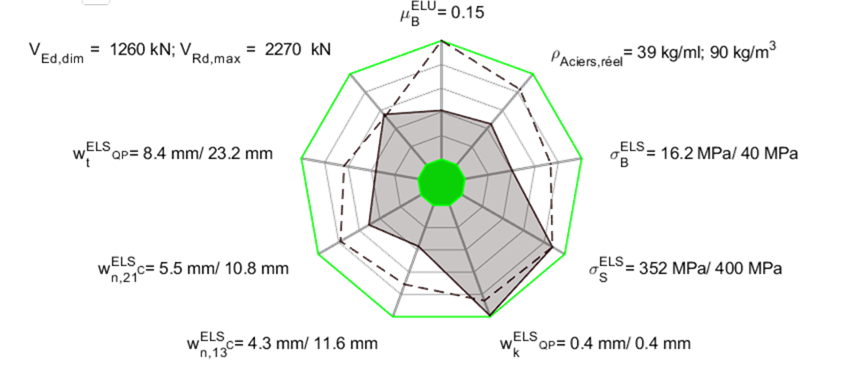
Illustration: Multi‑criteria radar chart for the analysis of a continuous beam during preliminary design (L‑SA internal tool)
Some of these developments are intended to evolve, depending on needs and field feedback, into distributable tools or dedicated software solutions.
Below are two commented examples of operational tools used within our projects.
Integral General Method (IGM) — EC2
The IGM applies the scope of non‑linear analysis proposed in EC2 §5.7(1).
It provides refined treatment of deformation and second‑order effects in columns, beams, walls, slabs and piles subjected to bending or combined axial‑bending, and modelled as line elements.
By solving the axial–flexural compatibility along the full length of the element, the MGI approach brings several direct benefits to projects:
Significant optimization of formwork and reinforcement
Especially for slender elements: tall walls, piles, columns. The exact numerical resolution of the mechanical problem enables, for example, the development of bar cut‑off diagrams or variation of formwork along the span according to local actions.
Unification of the classical EC2 models
This method allows treatment, within a single framework, of:
- beams,
- columns,
- and intermediate cases (multi‑supported columns, slabs in bending‑compression, etc.).
It also extends the analysis to a variety of elements with arbitrary initial deformation, loading, support conditions and (axisymmetric) section shapes, including geometries varying along the element length.
Enhanced analysis of structural phenomena
Thanks to a continuous representation of deformations, curvatures and stress distributions, MGI provides a deeper understanding of the physical behaviour of structures:
- second-order effect in piles
- shrinkage and thermal expansion effects,
- moment redistribution,
- formation of plastic hinges and rotation compatibility,
- progressive cracking of sections
IGM tool interface
Second‑order analysis of a simple industrial concrete frame column with variable cross‑section and reinforcement
Timber–Concrete Composite Modelling (TCM) — EC2/EC5
The TCM application addresses a specific operational need: refined analysis of timber–concrete composite beams. While standard design tools often reduce the system to an equivalent inertia beam in simple support, TCM provides a more accurate modelling of the timber‑concrete coupling, enabling a deeper analysis and broader use cases.
Precise modelling of the timber–concrete interaction
The tool computes the mechanical behaviour of each material, accounting for their interaction through the connectors, without using the simplifying assumption of a single equivalent inertia. It provides:
- progressive transfer of normal force between concrete slab and timber beam along the span,
- tracking of normal and shear forces in each connector,
- the ability to optimize connector layout according to the desired behaviour.
Ability to handle complex geometric configurations
MBB makes it possible to analyse situations beyond standard tools:
- arbitrary loading and support geometries, including continuous beams;
- timber and concrete sections varying by segment;
- consideration of slab reinforcement in stiffness;
- implementation of voids/reservations in the timber–concrete interface area for structural or service routing.
The model outputs stresses and deformations according to EC2 and EC5 limit states.
Construction phasing and time‑dependent effects
The application also integrates a unique modelling of construction phases, allowing assessment of:
- creep in timber and concrete,
- concrete shrinkage,
- loading history effects on the connection and deflections.
The memory of actions is incorporated directly into the strain fields (ε), ensuring a more faithful representation of the mixed system’s evolution over time.
MBB tool interface : teamber-concrete composite beam analysis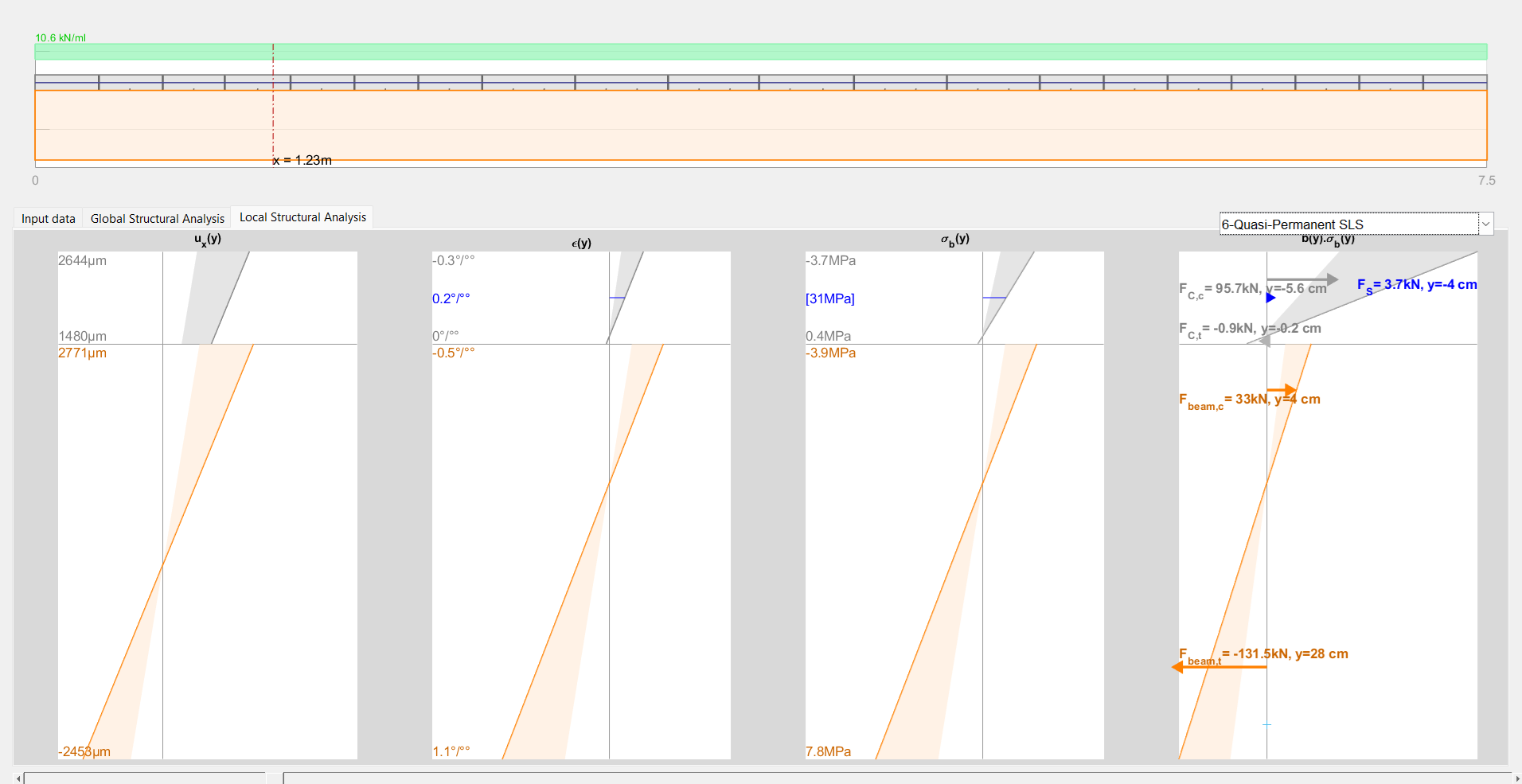
Learn more about L‑SA software
On OpenLAB, you can find detailed information on L‑SA software, their theoretical foundations and their operational applications, including:
• commented use cases,
• demonstration videos,
• technical articles presenting the principles of the various methods.
Are you interested in L‑SA’s numerical approach?
Whether the solutions presented directly address one of your operational needs, or you have specific digital expectations for your activity, feel free to contact us.
