
 FR
FR 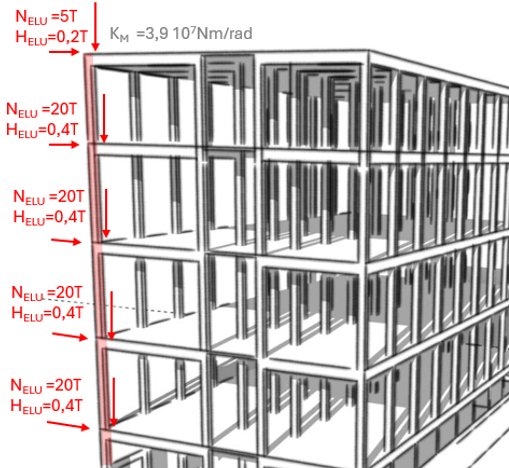
Residential and office buildings in reinforced concrete dating from the post‑war Reconstruction period (1945–1960) were not always designed with explicit consideration of lateral stability. In some buildings of that era, global bracing relies almost entirely on the hyperstatic continuity provided by beam‑column joints and shear keys, which are often lightly reinforced.
This example presents the analysis and justification of a flexible R+5 reinforced concrete frame building subjected to wind actions, which can be reduced to the study of a continuous reinforced concrete column, unbraced, loaded, and partially fixed at each floor level.
The calculation illustrates the benefits of the Integral General Method for addressing this type of configuration with full accuracy, including second‑order effects.
- Nicolas DUBREIL
- 16 mins
An approach to analyzing and designing horizontal structures subjected to shrinkage
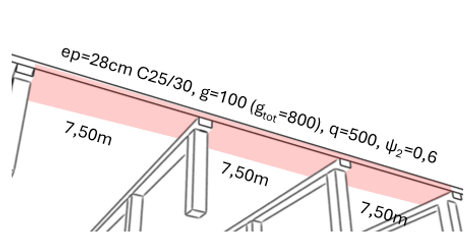
Eurocode 2 is relatively precise in determining the evolution of concrete shrinkage over time. However, it remains much more succinct regarding how to incorporate this phenomenon into reinforced concrete design calculations.
Beyond deformations alone, the engineer is often faced with determining bending moments, axial forces, stresses in reinforcement, as well as crack widths, particularly in restrained shrinkage configurations.
The example presented below shows how the General Integral Method (GIM) makes it possible to capture physical phenomena that are often anticipated but difficult to access using conventional approaches. It progressively highlights:
- axial elongation under gravity loads,
- reduction of the cracking moment due to shrinkage,
- increase in curvatures and deflections,
- as well as the determination of tensile force in cases of restrained shrinkage.
- Nicolas DUBREIL
- 9 mins
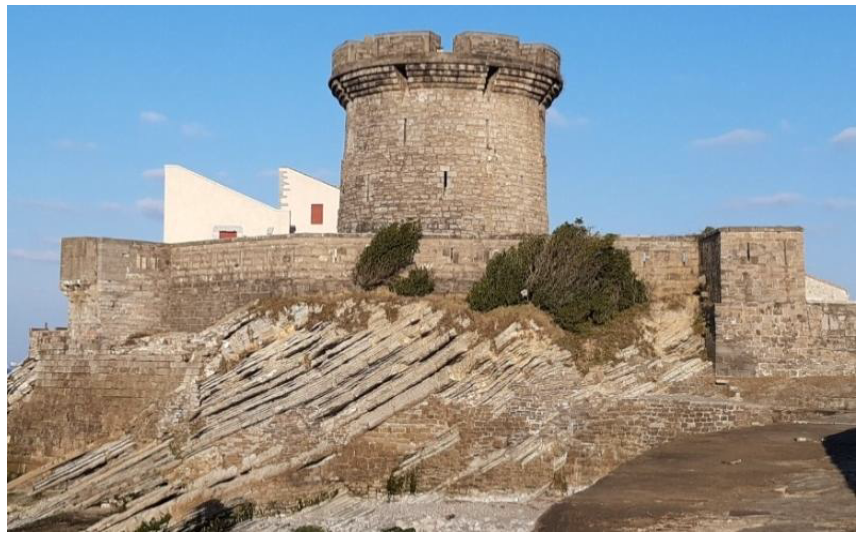
The opportunity to carry out a structural diagnosis of the Fort of Socoa made it possible to study the mechanical behaviour of an annular vault under seismic loading.
Far from modern engineering structures, this military construction raises fundamental questions.
- What modelling strategy should be used in an engineering context?
- How can the stereotomy and complex shapes of such a structure be approached?
- How should the seismic issue be considered within a regulatory framework sometimes ill-adapted to historic structures?
- What are the expected failure modes, and how do they compare to those of classical masonry structures?
- Which indicators and stability criteria should be retained?
To answer these questions, we propose a comprehensive methodology combining parametric geometric generation and structural analysis using the discrete element method.
This study reveals a unique collapse mechanism, hybrid between that of a dome and that of an arch. Above all, it once again demonstrates the ability of masonry to reach a new equilibrium state despite the presence of cracking, confirming the resilience of stone structures. This study thus offers a pathway for the structural justification of complex masonry works subjected to seismic actions.
- Vincent VENZAL
- 18 mins
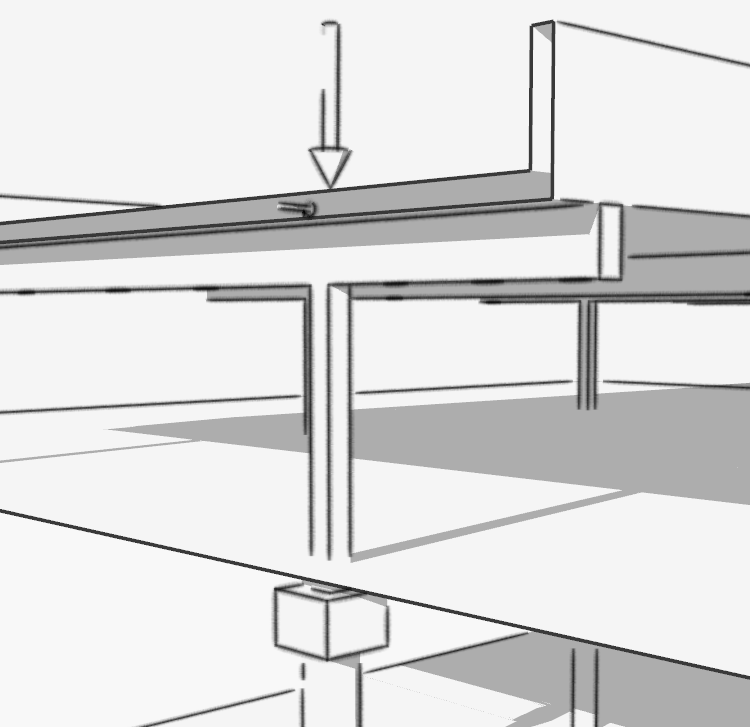
Using the example of a basic parking structure designed with a column–beam system, this article addresses the issues of bracing reinforced concrete buildings, associated best‑practice rules, and the technical constraints and calculations involved in a frame‑type system.
The example highlights horizontal actions that are usually negligible for a car park, but which should be considered when the structure becomes relatively flexible (with sway nodes). It also evaluates second‑order effects that become significant in such a structure.
The numerical solution of the system—made more complex by the absence of horizontal structural elements at the column–pile connection—is provided exactly using the General Integral Method, as an alternative to the use of SOUCHE (1984) design charts.
- Nicolas DUBREIL
- 13 mins
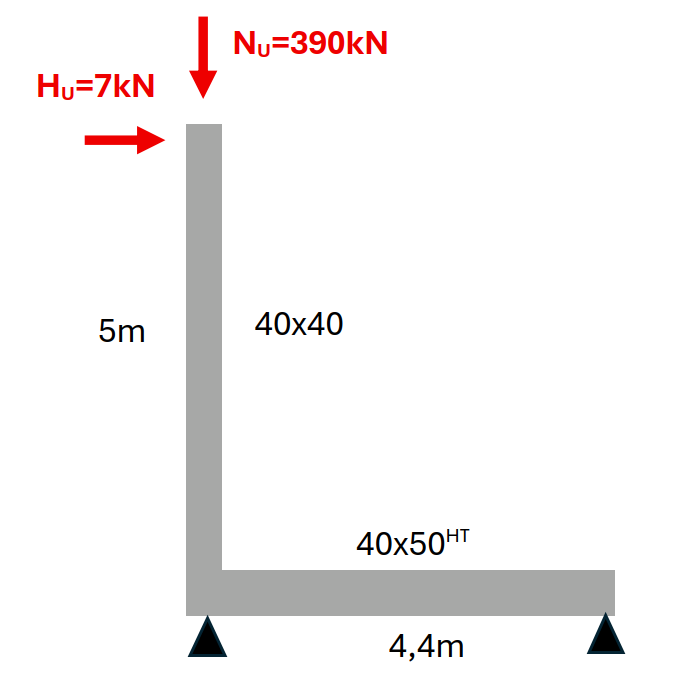
The partially fixed mast is a common configuration of reinforced concrete structures, which nevertheless remains poorly documented in the literature. Yet a partial fixity is a delicate assumption to handle.
This example offers a review of the data input process and the justification of such a calculation, according to the general EC2 method reduced to one critical section (MG1). It especially details various reminders and points of attention to monitor in order to successfully perform the design.
The end of the example shows the exact solution to the problem and the possible optimisation made possible by the integral general method (IGM).
- Nicolas DUBREIL
- 11 mins
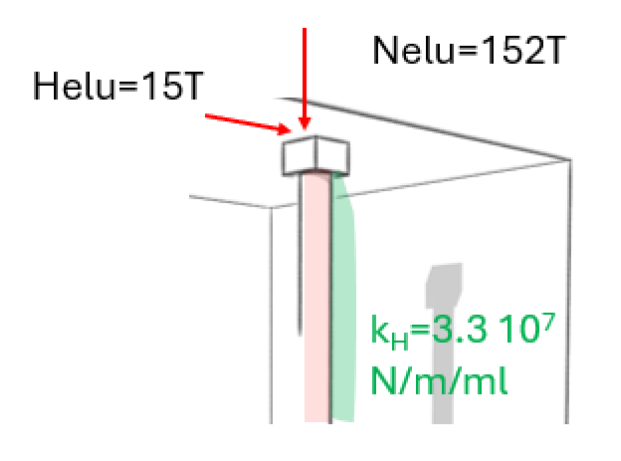
General Eurocode 2 Method Applied to Concrete Piles: Managing Second-Order Effects, Stresses, and Displacements
This article presents a nonlinear EC2-type approach (§5.7) for the design of a single pile under lateral loads.
The analysis of an isolated pile under lateral load is a common use case, usually treated as elastoplastic on the soil side and linear elastic on the pile side. The subject can also be seen as the analysis of a slender reinforced concrete column with intermediate elastic supports.
Once the soil behaviour and, in particular, the plastification depth are determined, this approach allows for an accurate assessment of second‑order effects, SLS and ULS stress criteria, and deformations, relying on the full EC2 framework.
- Nicolas DUBREIL
- 15 mins
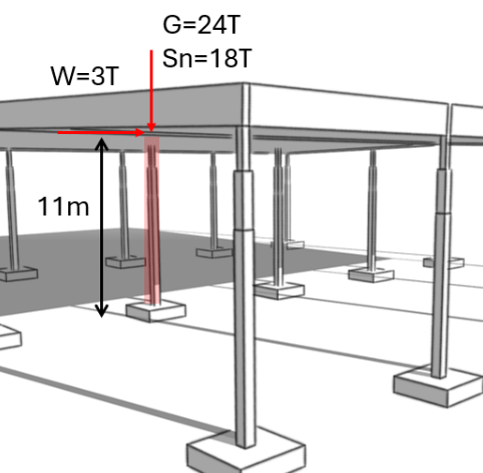
Applying the Eurocode 2 General Method reduced to the analysis of a critical section (MG1) relies on modelling the element as having a constant stiffness, enabling a simplified evaluation of second‑order effects and the justification of formwork and reinforcement—an approach typically extended, by principle, over the full height of the member.
However, in the case of precast reinforced‑concrete industrial columns, potentially produced in large series, it can be worthwhile to investigate section optimisation and reinforcement cut‑offs in order to reduce weight, cost and carbon footprint.
Optimising these reinforcement cut‑offs may also be of interest for more conventional pinned‑pinned RC columns, for example to simplify bar intersections at node locations, or in rehabilitation works when strengthening is required only in selected regions.
This example applies the Integral General Method to the case of a precast reinforced‑concrete industrial column, in order to explore these optimisation possibilities while ensuring full verification of the member in accordance with Eurocode 2.
[Article to be published soon]
- Nicolas DUBREIL
- 1 min
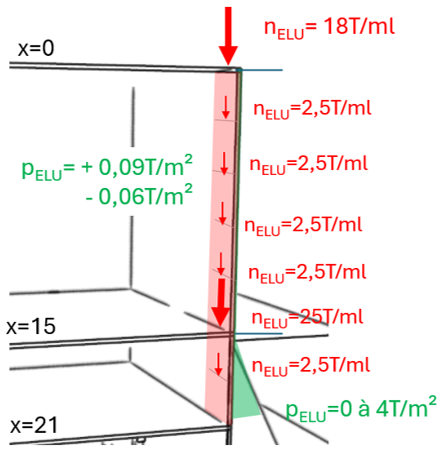
The design of tall reinforced‑concrete walls can be optimised in several ways: by taking advantage of continuity with adjacent storeys that are more favourable in terms of slenderness, by exploiting load asymmetry and adopting asymmetric reinforcement layouts, or by tailoring reinforcement cut‑offs when actions are locally concentrated (for example, earth pressure applied only to the lower portion of the wall).
Such optimisation requires a level of analytical detail beyond that of the standard Eurocode 2 General Method, together with engineering judgement to examine all governing load cases, choose the appropriate direction of geometric imperfections for each storey, and consider the various possible loading scenarios.
This article examines potential optimisation strategies for the design of a tall wall in continuity and subjected to asymmetric loading.
[Article to be published soon]
- Nicolas DUBREIL
- 1 min
