L-SA L-SA
  • Categories
    • Scientific and Technical Articles – Community Contributions
    • Site Feedback – Structural Project Case Studies and Lessons Learned
    • Calculation Notes – Real Cases and Applications
    • Downloadable Calculation Tools – Utilities and Methodological Guides
    • Professional Insights – Shared Contributions and Industry Watch
    • Themes
      • Structural materials
        • Soil-Geotechnics
        • Concrete
        • Reinforced concrete
        • Prestressed concrete
        • Steel
        • Steel-concrete composite
        • Aluminium
        • Cable
        • Timber
        • Timber-concrete composite
        • Timber-steel composite
        • Stone
        • Earth
        • Other material
      • Types of works
        • Ground reinforcement
        • Special foundation
        • Foundation
        • Slab-mat suspended slab
        • Retaining wall
        • Framework
        • Column
        • Beam
        • Wall
        • Floor slab
        • Facade
        • Structure (roof)
        • Roof
        • Other structure
      • Study phases
        • Assumptions
        • Design
        • Structural analysis and sizing
        • Construction provisions
        • Drawing
        • Description-specification
        • Construction monitoring
        • Diagnosis
        • Rehabilitation
        • Other study
      • Types of analysis
        • Gravity load analysis
        • Bracing
        • Seismic analysis
        • Fire scenario analysis
        • Deformation
        • Vibration
        • Durability
        • Environmental impact
        • Pathology
        • Other analysis
    • Featured
    • About
      • The OpenLAB project
      • OpenLAB Terms and Conditions
      • Contact us
      • L-SA
    • Login
    L-SA L-SA
    • Categories
      • Scientific and Technical Articles – Community Contributions
      • Site Feedback – Structural Project Case Studies and Lessons Learned
      • Calculation Notes – Real Cases and Applications
      • Downloadable Calculation Tools – Utilities and Methodological Guides
      • Professional Insights – Shared Contributions and Industry Watch
      • Themes
        • Structural materials
          • Soil-Geotechnics
          • Concrete
          • Reinforced concrete
          • Prestressed concrete
          • Steel
          • Steel-concrete composite
          • Aluminium
          • Cable
          • Timber
          • Timber-concrete composite
          • Timber-steel composite
          • Stone
          • Earth
          • Other material
        • Types of works
          • Ground reinforcement
          • Special foundation
          • Foundation
          • Slab-mat suspended slab
          • Retaining wall
          • Framework
          • Column
          • Beam
          • Wall
          • Floor slab
          • Facade
          • Structure (roof)
          • Roof
          • Other structure
        • Study phases
          • Assumptions
          • Design
          • Structural analysis and sizing
          • Construction provisions
          • Drawing
          • Description-specification
          • Construction monitoring
          • Diagnosis
          • Rehabilitation
          • Other study
        • Types of analysis
          • Gravity load analysis
          • Bracing
          • Seismic analysis
          • Fire scenario analysis
          • Deformation
          • Vibration
          • Durability
          • Environmental impact
          • Pathology
          • Other analysis
      • Featured
      • About
        • The OpenLAB project
        • OpenLAB Terms and Conditions
        • Contact us
        • L-SA
      • Login
      This article presents a general integral method (GIM) for the calculation of reinforced concrete columns and beams according to Eurocode 2

      An Integral General Method (IGM) in accordance with Eurocode 2

      This article presents the benefits of a nonlinear approach for the analysis of reinforced concrete line elements, intended to determine the unique solution of the mechanical problem — when it exists — by enforcing flexural and axial deformation compatibility at every point along the member.

      Inspired by the General Method and fully covered by Eurocode 2, this approach, referred to as the “Integral General Method” or IGM, opens up possibilities for analysing and optimising many common situations, from slender columns to continuous members in combined bending and compression.

      Nicolas DUBREIL
      10 mins
      Published 26 February 2026
      Version 23 June 2026
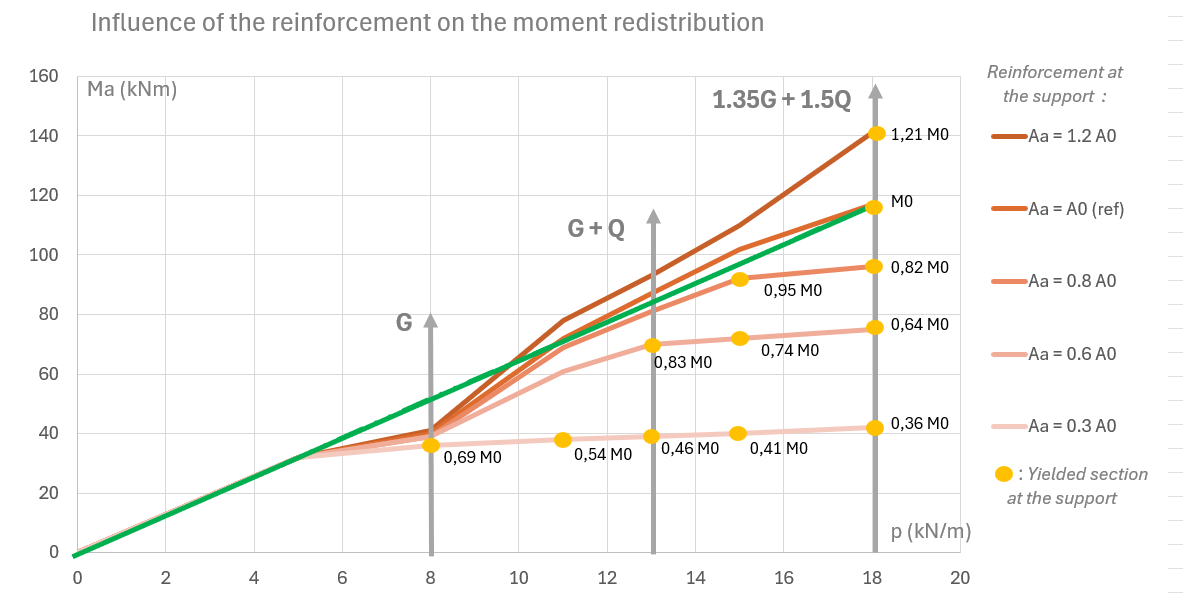
      Redistribution in reinforced concrete structures depends on cracking and plastification. Explanation of these mechanisms using non-linear analysis.

      Understanding Moment Redistribution through EC2 Non-Linear Analysis

      The behaviour of reinforced concrete flexural structures is intrinsically non-linear and depends on cracking and the progressive plastification of sections.

      Compared with earlier generation codes (BAEL), Eurocode 2 now benefits from the theoretical contributions required to take these phenomena into account, notably enabling the calculation-based treatment of concrete adaptation, the formation of plastic hinges, moment redistribution, as well as deformation compatibility issues.

      Depending on the required level of analysis, the code also allows simplified, regulated methods based on linear-elastic analyses, possibly combined with predefined moment redistributions.

      These various approaches provide the calculation framework with a certain versatility and give the engineer a degree of flexibility suited to the diversity of situations encountered in practice.

      While simplified analysis methods (§5.4 to §5.6) are widely used in practice, the present study proposes to utilize non-linear methods (§5.7) on simple cases in order to progressively highlight the mechanisms underlying structural analysis according to EC2, and to provide additional insight into linear-elastic analyses and redistribution practices.

      Nicolas DUBREIL
      20 mins
      Published 23 June 2026
      Version 23 June 2026
      The relationship between structural works and special foundations relies largely on the load path

      Load transfer on piles, construction tolerances, and support stiffnesses

      The relationship between structural works and special foundations relies largely on the Load Transfer Document (LTD), which, beyond a simple listing, can play a truly structuring role in the project design and in defining the interface between trades.

      When advantageously supplemented with information such as execution tolerance management and the stiffness to consider at the top of each pile, the LTD becomes a key element — relayed by the technical specifications (STS) — to clarify the boundary between trades and secure the design.

      This article provides specific insight into these sometimes‑confusing geometric, mechanical, and contractual aspects, and shows the value of documenting them early on.

      Nicolas DUBREIL
      25 mins
      Published 17 March 2026
      Version 27 March 2026

       Didn't find the information you were looking for?


      Join the OpenLAB community now to access all articles, take part in technical discussions, and find the answer you're looking for!

      The content published on OpenLAB is the sole responsibility of its authors. It is provided for informational purposes only, without any guarantee of accuracy, completeness, or timeliness. Its use is entirely at the user’s own risk.
      © 2026 Laboratoire Structures et Applications / OpenLAB members – All rights reserved. Legal Notice – Privacy Policy – OpenLAB Terms of Use – contact@l-sa.eu -  LinkedIn

      • Categories
        • Scientific and Technical Articles – Community Contributions
        • Site Feedback – Structural Project Case Studies and Lessons Learned
        • Calculation Notes – Real Cases and Applications
        • Downloadable Calculation Tools – Utilities and Methodological Guides
        • Professional Insights – Shared Contributions and Industry Watch
      • Themes
        • Structural materials
          • Soil-Geotechnics
          • Concrete
          • Reinforced concrete
          • Prestressed concrete
          • Steel
          • Steel-concrete composite
          • Aluminium
          • Cable
          • Timber
          • Timber-concrete composite
          • Timber-steel composite
          • Stone
          • Earth
          • Other material
        • Types of works
          • Ground reinforcement
          • Special foundation
          • Foundation
          • Slab-mat suspended slab
          • Retaining wall
          • Framework
          • Column
          • Beam
          • Wall
          • Floor slab
          • Facade
          • Structure (roof)
          • Roof
          • Other structure
        • Study phases
          • Assumptions
          • Design
          • Structural analysis and sizing
          • Construction provisions
          • Drawing
          • Description-specification
          • Construction monitoring
          • Diagnosis
          • Rehabilitation
          • Other study
        • Types of analysis
          • Gravity load analysis
          • Bracing
          • Seismic analysis
          • Fire scenario analysis
          • Deformation
          • Vibration
          • Durability
          • Environmental impact
          • Pathology
          • Other analysis
      • Featured
      • About
        • The OpenLAB project
        • OpenLAB Terms and Conditions
        • Contact us
        • L-SA
      • Login