
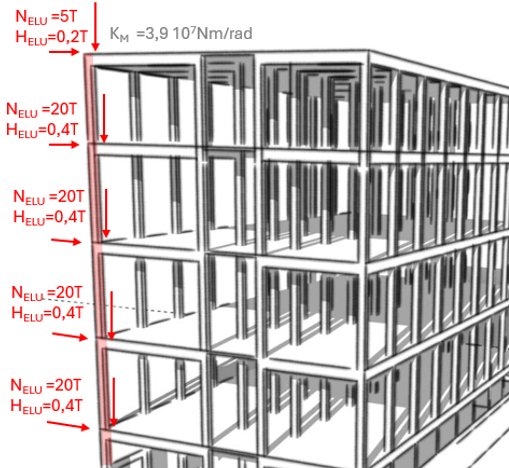
Residential and office buildings in reinforced concrete dating from the post‑war Reconstruction period (1945–1960) were not always designed with explicit consideration of lateral stability. In some buildings of that era, global bracing relies almost entirely on the hyperstatic continuity provided by beam‑column joints and shear keys, which are often lightly reinforced.
This example presents the analysis and justification of a flexible R+5 reinforced concrete frame building subjected to wind actions, which can be reduced to the study of a continuous reinforced concrete column, unbraced, loaded, and partially fixed at each floor level.
The calculation illustrates the benefits of the Integral General Method for addressing this type of configuration with full accuracy, including second‑order effects.
- Nicolas DUBREIL
- 16 mins
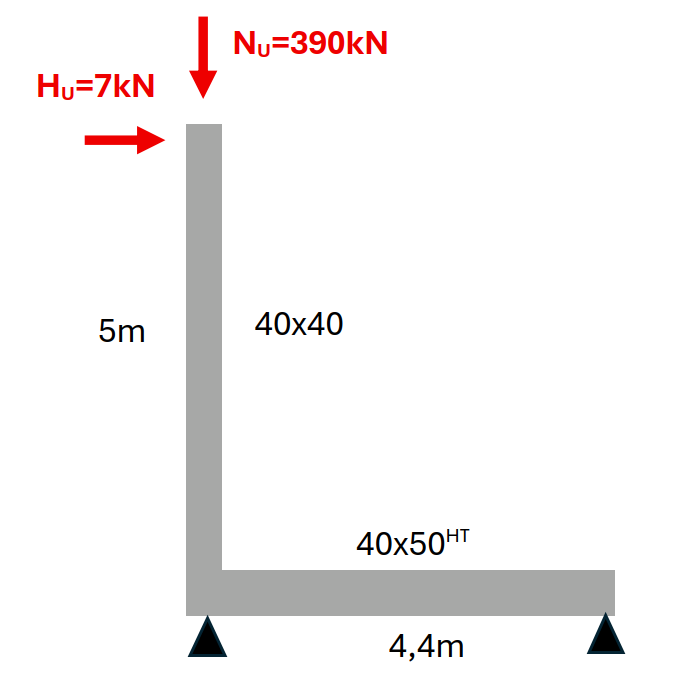
The partially fixed mast is a common configuration of reinforced concrete structures, which nevertheless remains poorly documented in the literature. Yet a partial fixity is a delicate assumption to handle.
This example offers a review of the data input process and the justification of such a calculation, according to the general EC2 method reduced to one critical section (MG1). It especially details various reminders and points of attention to monitor in order to successfully perform the design.
The end of the example shows the exact solution to the problem and the possible optimisation made possible by the integral general method (IGM).
- Nicolas DUBREIL
- 11 mins
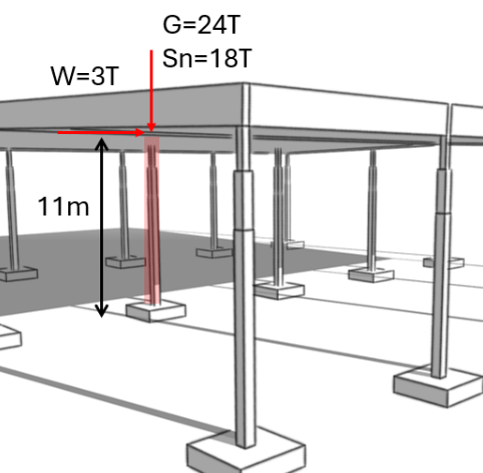
Applying the Eurocode 2 General Method reduced to the analysis of a critical section (MG1) relies on modelling the element as having a constant stiffness, enabling a simplified evaluation of second‑order effects and the justification of formwork and reinforcement—an approach typically extended, by principle, over the full height of the member.
However, in the case of precast reinforced‑concrete industrial columns, potentially produced in large series, it can be worthwhile to investigate section optimisation and reinforcement cut‑offs in order to reduce weight, cost and carbon footprint.
Optimising these reinforcement cut‑offs may also be of interest for more conventional pinned‑pinned RC columns, for example to simplify bar intersections at node locations, or in rehabilitation works when strengthening is required only in selected regions.
This example applies the Integral General Method to the case of a precast reinforced‑concrete industrial column, in order to explore these optimisation possibilities while ensuring full verification of the member in accordance with Eurocode 2.
[Article to be published soon]
- Nicolas DUBREIL
- 1 min
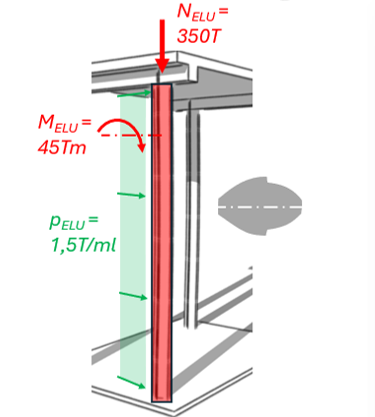
This article presents the benefits of the Integral General Method for justifying the design of specific architectural columns featuring curved profiles and/or non‑standard cross‑sections, with the sole requirement that the mechanical problem admits a plane of symmetry, allowing the analysis to be reduced to a 2D system in combined bending with second‑order effects.
The worked example demonstrates the calculation of stresses and deformations, as well as the verification of deformation compatibility at every section, and compliance with Eurocode 2 criteria for such a column.
[Article to be published soon]
- Nicolas DUBREIL
- 1 min
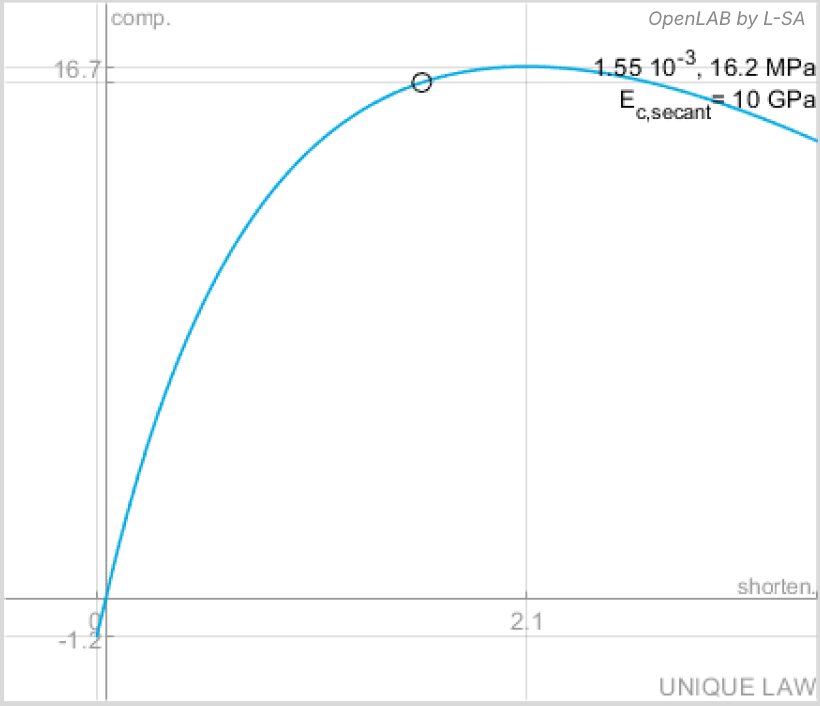
This article presents the benefits of a nonlinear approach for the analysis of reinforced concrete line elements, intended to determine the unique solution of the mechanical problem — when it exists — by enforcing flexural and axial deformation compatibility at every point along the member.
Inspired by the General Method and fully covered by Eurocode 2, this approach, referred to as the “Integral General Method” or IGM, opens up possibilities for analysing and optimising many common situations, from slender columns to continuous members in combined bending and compression.
- Nicolas DUBREIL
- 10 mins
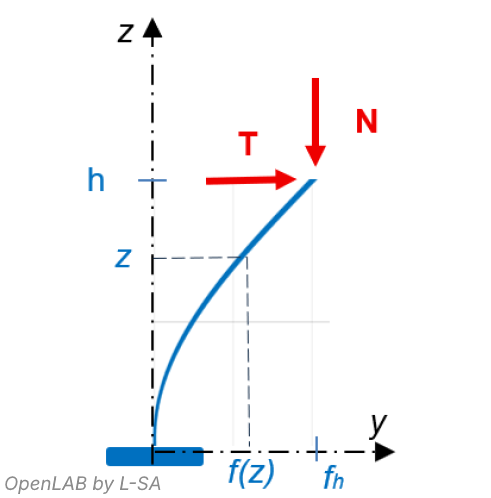
Introduction to the MG1 General Method of Eurocode 2 for the Design of Concrete Columns: Foundations, Usage Limitations, and Key Points of Attention.
The general method for column design according to Eurocode 2, and more specifically the simplified option of this method, referred to as MG1 in this document, is an important everyday tool for the reinforced concrete structural engineer. It makes it possible to significantly reduce the theoretical complexity of studying a slender reinforced concrete column or wall, by approximating second-order effects.
However, this method has usage limitations and caution points that can sometimes be difficult to master, especially since spreadsheet implementations—commonly used in design offices—may hide certain important concepts.
This four-part dossier offers a review of the different calculation steps of the general method, with a focus on various influential aspects. This Part 1 provides a reminder of the fundamentals of the general method.
- Nicolas DUBREIL
- 8 mins
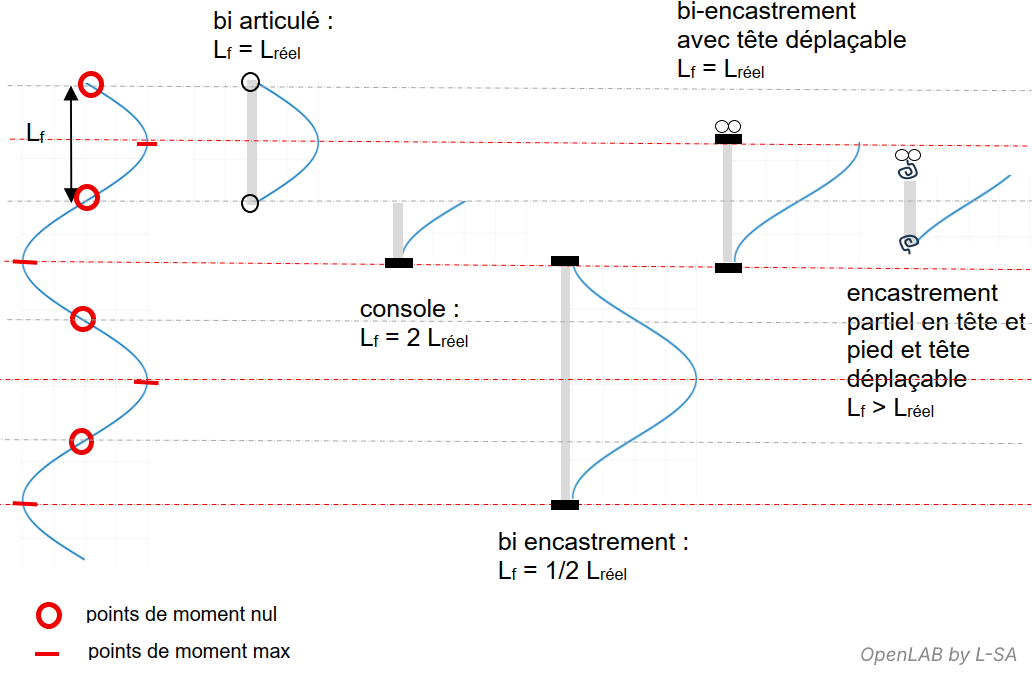
Analysis of the MG1 General Method: The Impact of the Deformation Shape on the Design of RC Columns and Walls.
The general method for column design according to Eurocode 2 is an important everyday tool for the reinforced concrete structural engineer. It makes it possible to significantly reduce the theoretical complexity of studying a slender reinforced concrete column or wall, by approximating second-order effects.
However, this method has usage limitations and caution points that can sometimes be difficult to master, especially since spreadsheet implementations—commonly used in design offices—may hide certain important concepts.
This four-part dossier offers a review of the different calculation steps of the general method, with a focus on various influential aspects. This Part 2 provides a focus on one of the underlying assumptions of the method: the shape of the deformation.
- Nicolas DUBREIL
- 8 mins
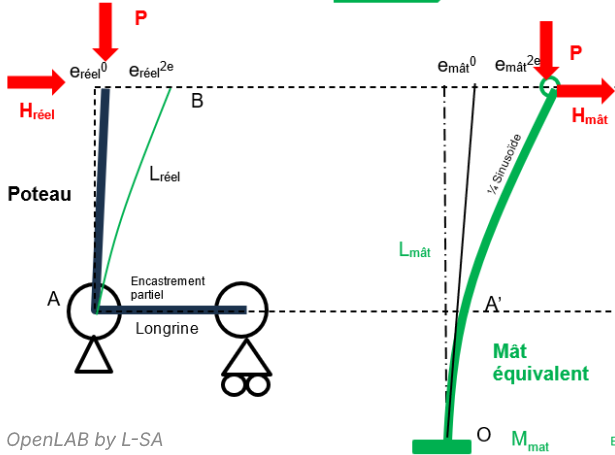
MG1 General Method : Evaluation of the First-Order Moment and End Stiffnesses to Be Considered in the Design of Columns and Walls.
The general method for column design according to Eurocode 2 is an important everyday tool for the reinforced concrete structural engineer. It makes it possible to significantly reduce the theoretical complexity of studying a slender reinforced concrete column or wall, by approximating second-order effects.
However, this method has usage limitations and caution points that can sometimes be difficult to master, especially since spreadsheet implementations—commonly used in design offices—may hide certain important concepts.
This four-part dossier offers a review of the different calculation steps of the general method, with a focus on various influential aspects. This Part 3 details several key caution points regarding the determination of the first-order bending moment to be considered and the evaluation of the boundary stiffnesses to be adopted.
- Nicolas DUBREIL
- 9 mins
