
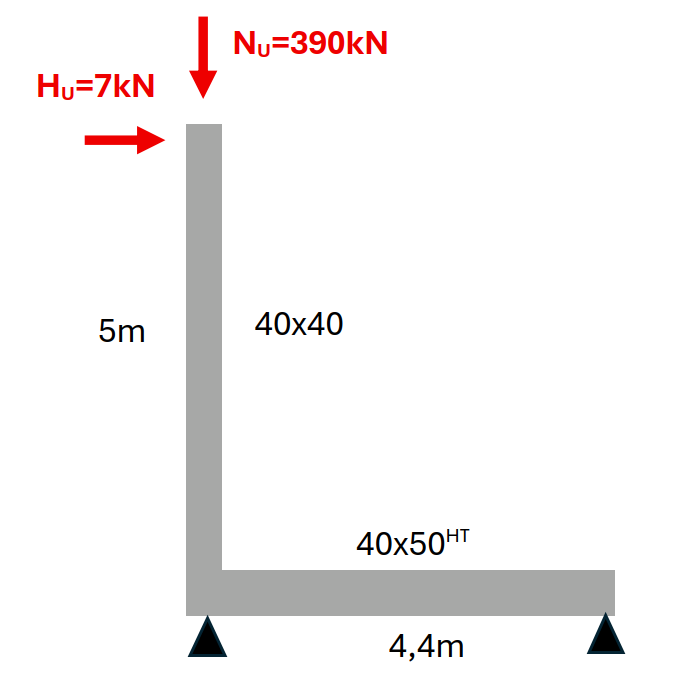
The partially fixed mast is a common configuration of reinforced concrete structures, which nevertheless remains poorly documented in the literature. Yet a partial fixity is a delicate assumption to handle.
This example offers a review of the data input process and the justification of such a calculation, according to the general EC2 method reduced to one critical section (MG1). It especially details various reminders and points of attention to monitor in order to successfully perform the design.
The end of the example shows the exact solution to the problem and the possible optimisation made possible by the integral general method (IGM).
- Nicolas DUBREIL
- 11 mins
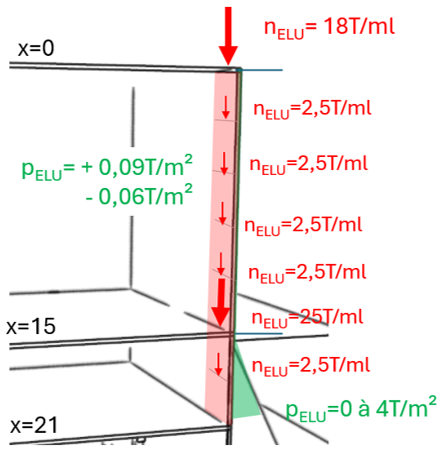
The design of tall reinforced‑concrete walls can be optimised in several ways: by taking advantage of continuity with adjacent storeys that are more favourable in terms of slenderness, by exploiting load asymmetry and adopting asymmetric reinforcement layouts, or by tailoring reinforcement cut‑offs when actions are locally concentrated (for example, earth pressure applied only to the lower portion of the wall).
Such optimisation requires a level of analytical detail beyond that of the standard Eurocode 2 General Method, together with engineering judgement to examine all governing load cases, choose the appropriate direction of geometric imperfections for each storey, and consider the various possible loading scenarios.
This article examines potential optimisation strategies for the design of a tall wall in continuity and subjected to asymmetric loading.
[Article to be published soon]
- Nicolas DUBREIL
- 1 min
The Eurocode 2 General Method reduced to the analysis of a critical section (MG1) relies on a strong assumption regarding the shape of the deformed configuration, which is often taken as sinusoidal. This sinusoidal form derives from the case of an elastic column subjected to a negligible first‑order effect, just sufficient to bring the column out of its unstable equilibrium state (y(x)=0) and generate an instability that leads to an increasing deformation until a stable equilibrium is reached.
In a case such as a pinned‑pinned column subjected to progressive axial loading and bending moments at different locations along its height, the sinusoidal model becomes very unrealistic. Using the General Method allows an exact global‑stability verification at ULS without any assumption on the shape of the deformation, and an SLS calculation of total and serviceability‑critical deformation, while satisfying all Eurocode 2 requirements.
This article also proposes an extrapolation of Eurocode 3 to define acceptable horizontal‑displacement criteria for this type of slender structure.
[Article to be published soon]
- Nicolas DUBREIL
- 2 mins
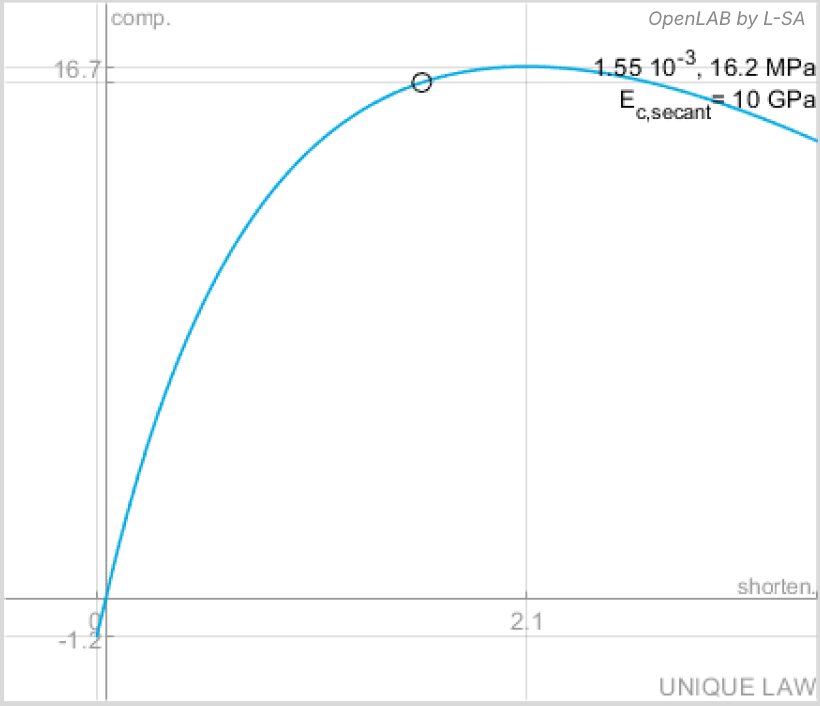
This article presents the benefits of a nonlinear approach for the analysis of reinforced concrete line elements, intended to determine the unique solution of the mechanical problem — when it exists — by enforcing flexural and axial deformation compatibility at every point along the member.
Inspired by the General Method and fully covered by Eurocode 2, this approach, referred to as the “Integral General Method” or IGM, opens up possibilities for analysing and optimising many common situations, from slender columns to continuous members in combined bending and compression.
- Nicolas DUBREIL
- 10 mins
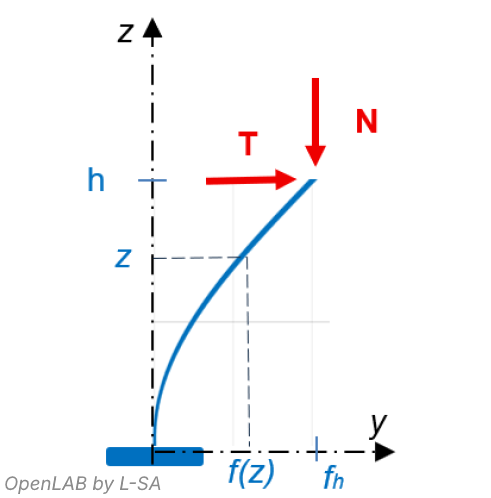
Introduction to the MG1 General Method of Eurocode 2 for the Design of Concrete Columns: Foundations, Usage Limitations, and Key Points of Attention.
The general method for column design according to Eurocode 2, and more specifically the simplified option of this method, referred to as MG1 in this document, is an important everyday tool for the reinforced concrete structural engineer. It makes it possible to significantly reduce the theoretical complexity of studying a slender reinforced concrete column or wall, by approximating second-order effects.
However, this method has usage limitations and caution points that can sometimes be difficult to master, especially since spreadsheet implementations—commonly used in design offices—may hide certain important concepts.
This four-part dossier offers a review of the different calculation steps of the general method, with a focus on various influential aspects. This Part 1 provides a reminder of the fundamentals of the general method.
- Nicolas DUBREIL
- 8 mins
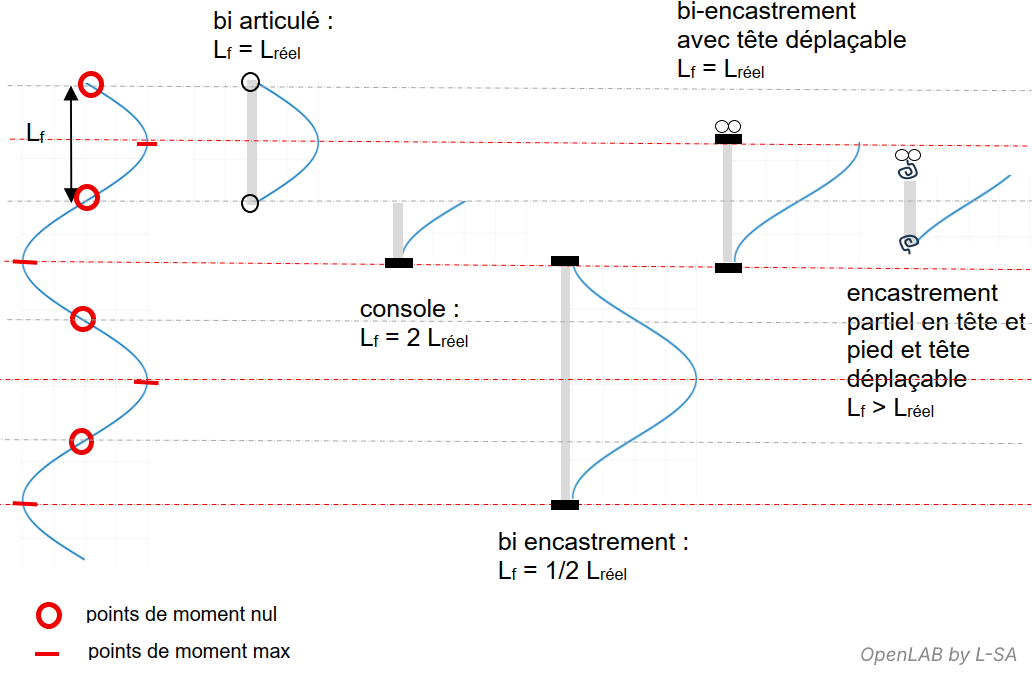
Analysis of the MG1 General Method: The Impact of the Deformation Shape on the Design of RC Columns and Walls.
The general method for column design according to Eurocode 2 is an important everyday tool for the reinforced concrete structural engineer. It makes it possible to significantly reduce the theoretical complexity of studying a slender reinforced concrete column or wall, by approximating second-order effects.
However, this method has usage limitations and caution points that can sometimes be difficult to master, especially since spreadsheet implementations—commonly used in design offices—may hide certain important concepts.
This four-part dossier offers a review of the different calculation steps of the general method, with a focus on various influential aspects. This Part 2 provides a focus on one of the underlying assumptions of the method: the shape of the deformation.
- Nicolas DUBREIL
- 8 mins
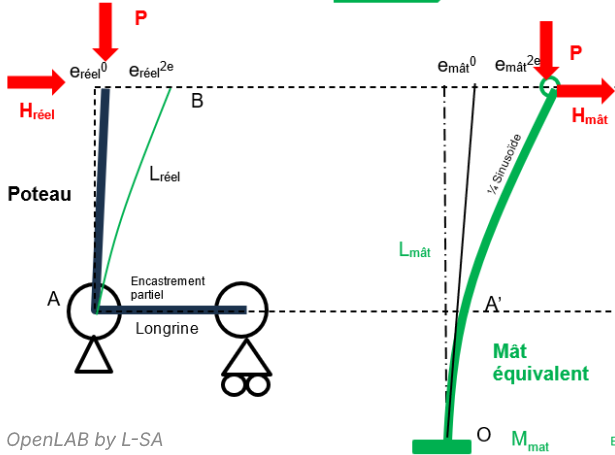
MG1 General Method : Evaluation of the First-Order Moment and End Stiffnesses to Be Considered in the Design of Columns and Walls.
The general method for column design according to Eurocode 2 is an important everyday tool for the reinforced concrete structural engineer. It makes it possible to significantly reduce the theoretical complexity of studying a slender reinforced concrete column or wall, by approximating second-order effects.
However, this method has usage limitations and caution points that can sometimes be difficult to master, especially since spreadsheet implementations—commonly used in design offices—may hide certain important concepts.
This four-part dossier offers a review of the different calculation steps of the general method, with a focus on various influential aspects. This Part 3 details several key caution points regarding the determination of the first-order bending moment to be considered and the evaluation of the boundary stiffnesses to be adopted.
- Nicolas DUBREIL
- 9 mins
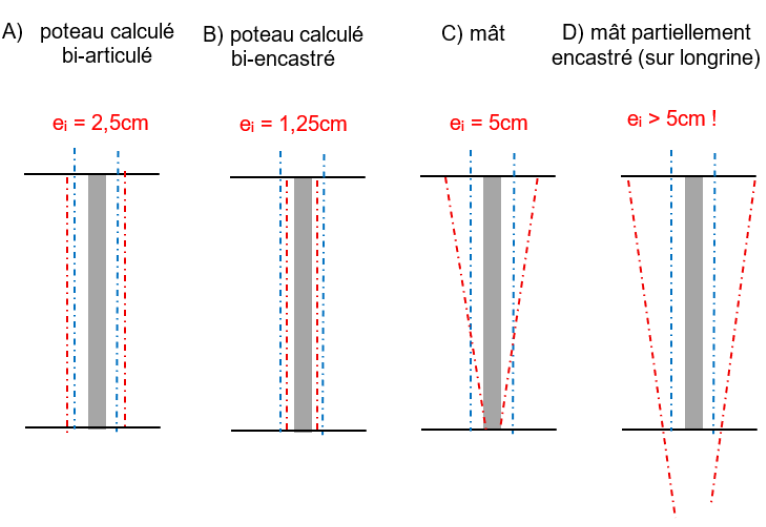
MG1 General Method : Implications of Construction Tolerances on Design, the Impact of Serviceability Deformations, and Verification of Supports.
The general method for column design according to Eurocode 2 is an important everyday tool for the reinforced concrete structural engineer. It makes it possible to significantly reduce the theoretical complexity of studying a slender reinforced concrete column or wall, by approximating second-order effects.
However, this method has usage limitations and caution points that can sometimes be difficult to master, especially since spreadsheet implementations—commonly used in design offices—may hide certain important concepts.
This four-part dossier offers a review of the different calculation steps of the general method, with a focus on various influential aspects.This Part 4, the final part of the series, develops several topics often addressed only briefly, such as construction tolerances, serviceability deformations and the justification of second‑order effects.
- Nicolas DUBREIL
- 6 mins
