
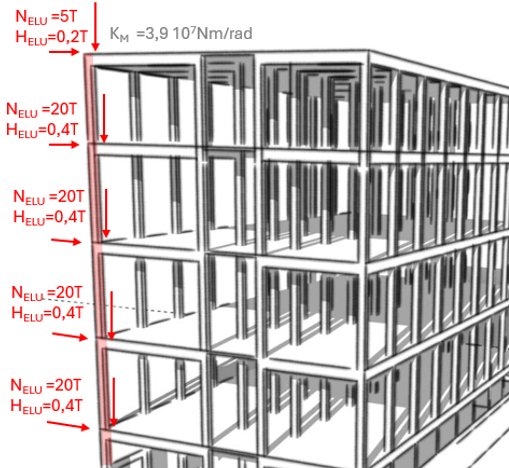
Residential and office buildings in reinforced concrete dating from the post‑war Reconstruction period (1945–1960) were not always designed with explicit consideration of lateral stability. In some buildings of that era, global bracing relies almost entirely on the hyperstatic continuity provided by beam‑column joints and shear keys, which are often lightly reinforced.
This example presents the analysis and justification of a flexible R+5 reinforced concrete frame building subjected to wind actions, which can be reduced to the study of a continuous reinforced concrete column, unbraced, loaded, and partially fixed at each floor level.
The calculation illustrates the benefits of the Integral General Method for addressing this type of configuration with full accuracy, including second‑order effects.
- Nicolas DUBREIL
- 16 mins
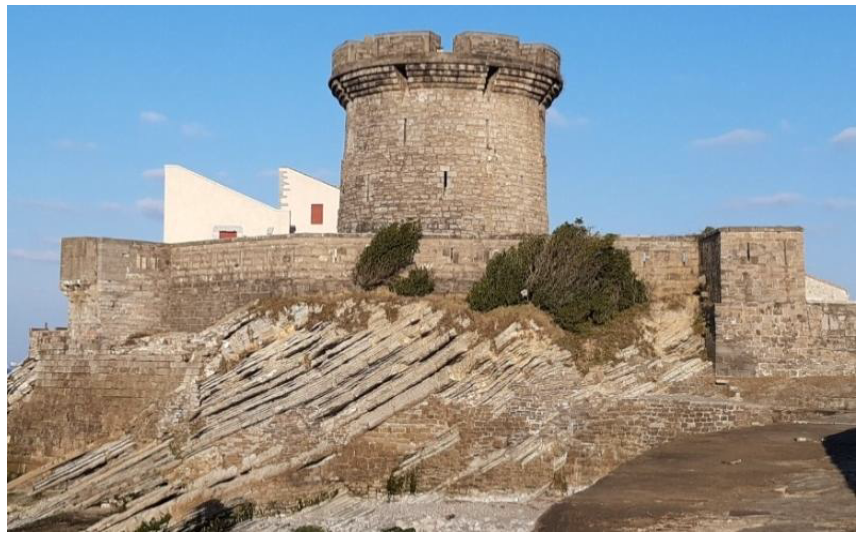
The opportunity to carry out a structural diagnosis of the Fort of Socoa made it possible to study the mechanical behaviour of an annular vault under seismic loading.
Far from modern engineering structures, this military construction raises fundamental questions.
- What modelling strategy should be used in an engineering context?
- How can the stereotomy and complex shapes of such a structure be approached?
- How should the seismic issue be considered within a regulatory framework sometimes ill-adapted to historic structures?
- What are the expected failure modes, and how do they compare to those of classical masonry structures?
- Which indicators and stability criteria should be retained?
To answer these questions, we propose a comprehensive methodology combining parametric geometric generation and structural analysis using the discrete element method.
This study reveals a unique collapse mechanism, hybrid between that of a dome and that of an arch. Above all, it once again demonstrates the ability of masonry to reach a new equilibrium state despite the presence of cracking, confirming the resilience of stone structures. This study thus offers a pathway for the structural justification of complex masonry works subjected to seismic actions.
- Vincent VENZAL
- 18 mins
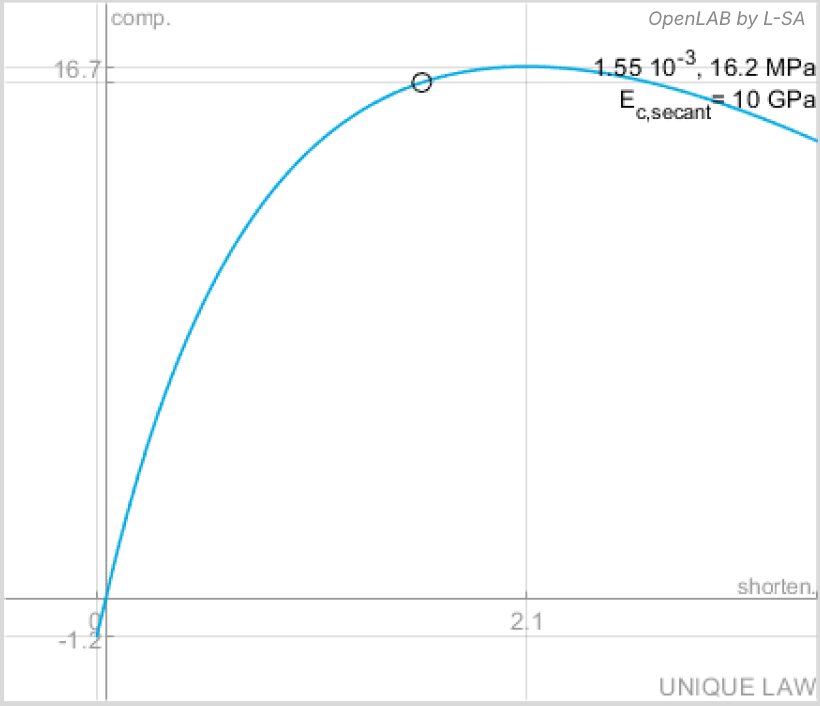
This article presents the benefits of a nonlinear approach for the analysis of reinforced concrete line elements, intended to determine the unique solution of the mechanical problem — when it exists — by enforcing flexural and axial deformation compatibility at every point along the member.
Inspired by the General Method and fully covered by Eurocode 2, this approach, referred to as the “Integral General Method” or IGM, opens up possibilities for analysing and optimising many common situations, from slender columns to continuous members in combined bending and compression.
- Nicolas DUBREIL
- 10 mins
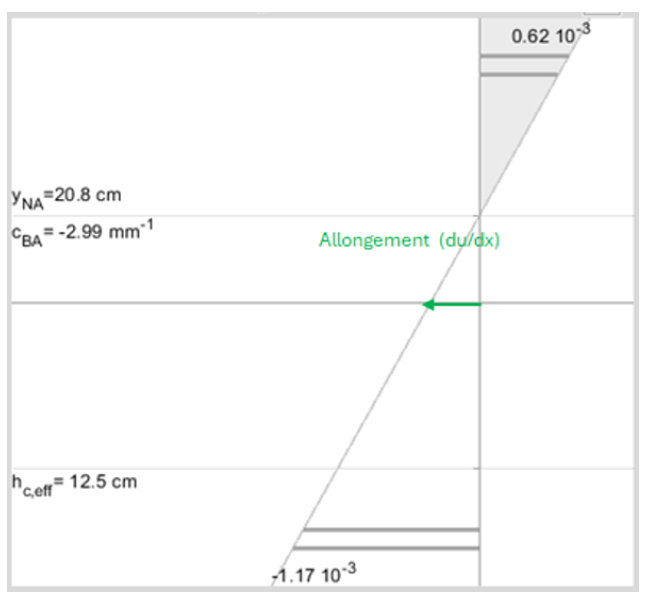
Analysis of a little‑known axial phenomenon: the elongation of simply‑bent RC beams under gravity loads, a direct consequence of reinforced‑concrete behaviour.
This article introduces the first axial effect observable in flexural reinforced‑concrete elements: the elongation of simply‑bent beams under gravity loads.
This phenomenon—often overlooked despite being non‑negligible—results directly from the fundamental behaviour of reinforced concrete, especially once cracking develops. Understanding it is essential before rigorously addressing the effects of thermal expansion and shrinkage.
It forms the first part of the series “Axial behaviour of flexural reinforced‑concrete elements” (1/4).
- Nicolas DUBREIL
- 6 mins
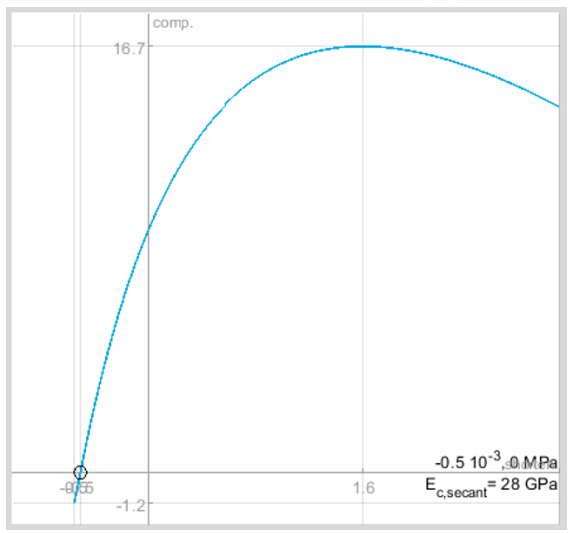
Thermo‑mechanical analysis of RC sections: constitutive laws, effects of thermal expansion and thermal gradients, and cases where EC2 requires their consideration.
This article examines the thermo‑mechanical behaviour of reinforced‑concrete members subjected to thermal expansion or thermal gradients, based on the assumptions of Eurocode 2.
It first analyses how the constitutive laws of concrete and steel are modified and how the mechanical diagrams of RC sections (strains, stresses, internal forces) evolve under thermal actions.
The article then reviews the regulatory situations in which thermal effects must be considered, illustrates the physical behaviour that can be observed, and presents the gravity/thermal concomitances that may become governing.
This is the second part of the series “Axial behaviour of flexural reinforced‑concrete elements” (2/4).
- Nicolas DUBREIL
- 8 mins
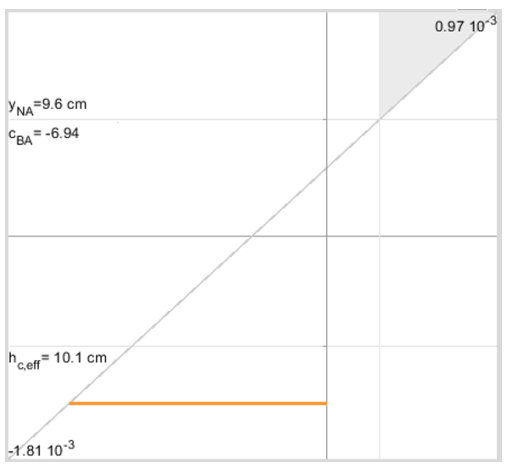
Analysis of concrete shrinkage, the induced self‑stresses, the differences with thermal effects, and the conditions for applying EC2 formula (7.21).
This article examines the mechanical behaviour of reinforced concrete subjected to shrinkage, highlighting the fundamental differences between shrinkage and thermal effects, and introducing the notion of self‑stresses that develop within the section.
It then analyses how the constitutive laws of concrete and steel are modified and how the mechanical diagrams of a reinforced‑concrete section (geometry, strains, stresses, internal forces) evolve under shrinkage.
Finally, the article clarifies the conditions under which Eurocode 2 formula (7.21)—used to estimate the curvature of a flexural member due to shrinkage—can be validly applied.
This contribution forms the third part of the series “Axial behaviour of flexural reinforced‑concrete elements” (3/4).
- Nicolas DUBREIL
- 9 mins
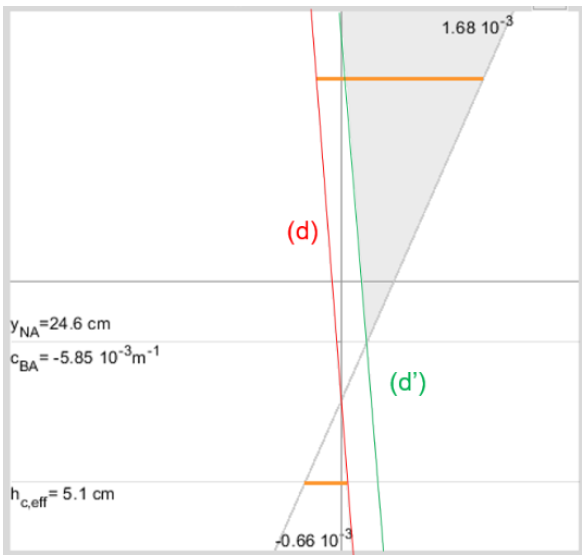
Synthesis of simultaneous axial effects: shrinkage, thermal actions, gravity‑induced elongation, cracking, and the limitations of elastic analyses.
This final part broadens the analysis of axial effects by considering the concomitance between shrinkage, thermal expansion and gravity‑induced elongation, as well as the impact of cracking.
The article highlights several points of vigilance regarding the elastic structural analysis of axial effects, and proposes that shrinkage studies should systematically include the effect of gravity‑induced elongation, and that thermal analyses at the characteristic SLS should jointly include shrinkage + gravity effects.
It constitutes the fourth part of the series “Axial behaviour of flexural reinforced‑concrete elements” (4/4).
- Nicolas DUBREIL
- 11 mins
